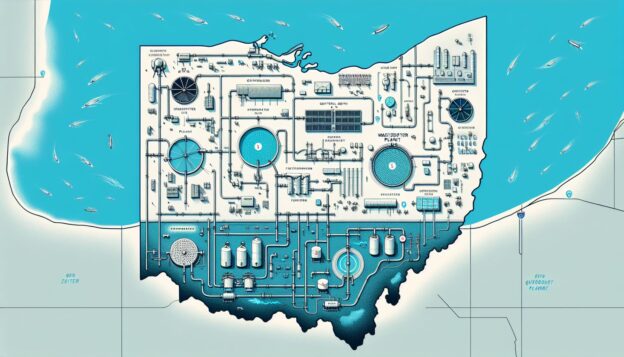
Being home to more than 11 million citizens, Ohio, famed as the Buckeye State, takes on an enormous effort to manage its wastewater effectively. This largely revolves around an extensive network of wastewater treatment plants (WWTPs) scattered across the state. But do we ever think about their locations or how the infrastructure is maintained and upgraded? Let’s shed light on Ohio’s wastewater treatment plant infrastructure, from their strategic locations to infrastructure mapping.
Ohio’s Wastewater Treatment Landscape: Geographic Widespread
Ohio’s urban and rural landscapes alike teem with a vast array of wastewater treatment facilities, each playing a critical role in managing and treating millions of gallons of wastewater daily. According to data from the United States Environmental Protection Agency (EPA), Ohio houses around 1,080 municipal wastewater treatment plants, serving an estimated population of 10.7 million.
Wondering about their distribution? The geographical locations of these facilities are typically determined by population density, local topography, and the catchment area they serve. For instance, densely populated areas like Cleveland and Cincinnati are bristling with multiple wastewater treatment plants, while sparsely populated regions may be served by a single, central facility.
Indeed, the practicality of a plant’s location is vital. A case in point is the Southerly Wastewater Treatment Plant, one of the largest in Ohio. Nestled on a 400-acre site in the Cuyahoga River Valley, it expeditiously processes an average of 125 million gallons of wastewater daily for over 601,000 residents within multiple municipalities in the Greater Cleveland area.
Infrastructure Mapping: A Cornerstone for Effective Wastewater Management
Mapping the infrastructure of Ohio’s wastewater treatment plants isn’t just an academic exercise; it’s a cornerstone for effective wastewater management. Why so? Infrastructure mapping provides a crucial visual representation of assets and resources, necessary for strategic planning, asset management, process optimization, and future expansions.
One resource that’s been instrumental in the task of mapping and documenting the state’s wastewater treatment facilities is Ohio wastewater treatment plants. This interactive map provides a detailed overview of the state’s WWTPs, from plant-specific specs and treatment capacities to service areas and associated regulatory standards. Such comprehensive data insights are central to informed decision-making, performance tracking, and strategic planning.
The Role of Geographic Information Systems (GIS)
And where does Geographic Information Systems (GIS) come in? GIS tools provide technologically advanced means to visualize, understand, and interpret data linked to Ohio’s wastewater treatment locations and infrastructures. Assets can be dynamically mapped in real-time, enabling plant operators to track, manage, and optimize processes.
GIS not only highlights the actual physical location of plants but also maps out infrastructure elements like sewer lines, valves, lift stations, and outfall locations. This dynamic visualization helps track operational changes, optimize logistics, schedule maintenance effectively, and identify areas for system enhancements.
The Future of Ohio’s Wastewater Treatment: Modernization and Upgrades
Given the significance of wastewater treatment in maintaining public health and environmental quality, Ohio continually seeks innovative methods to modernize and upgrade its existing wastewater treatment infrastructure.
From optimizing energy usage to deploying advanced treatment technologies like membrane bioreactors, the state’s treatment facilities are constantly evolving. We’ve also seen an increased adoption of smart technology and IoT-based systems that facilitate efficient data collection and decision-making, improving the efficacy of wastewater management.
An excellent example of this modernization is the Akron Water Reclamation Facility (WRF). It recently underwent a $1.2 billion upgrade, employing state-of-the-art technology to improve nutrient removal, reduce overflows, and enhance the facility’s overall sustainability.
In Conclusion
Managing and treating wastewater is a colossal undertaking, particularly for a state as populous as Ohio. The efficient operation of Ohio’s wastewater treatment plants, their strategic placement, and rigorous infrastructure mapping ensure that these facilities continue to serve the state’s residents effectively, today and well into the future.
Surely, while a large part of their work goes unseen and often unappreciated, it’s the seamless functioning of these facilities that afford us the comfort of turning on a tap or flushing a toilet without a second thought – a testament to Ohio’s commitment to sustainable water management.